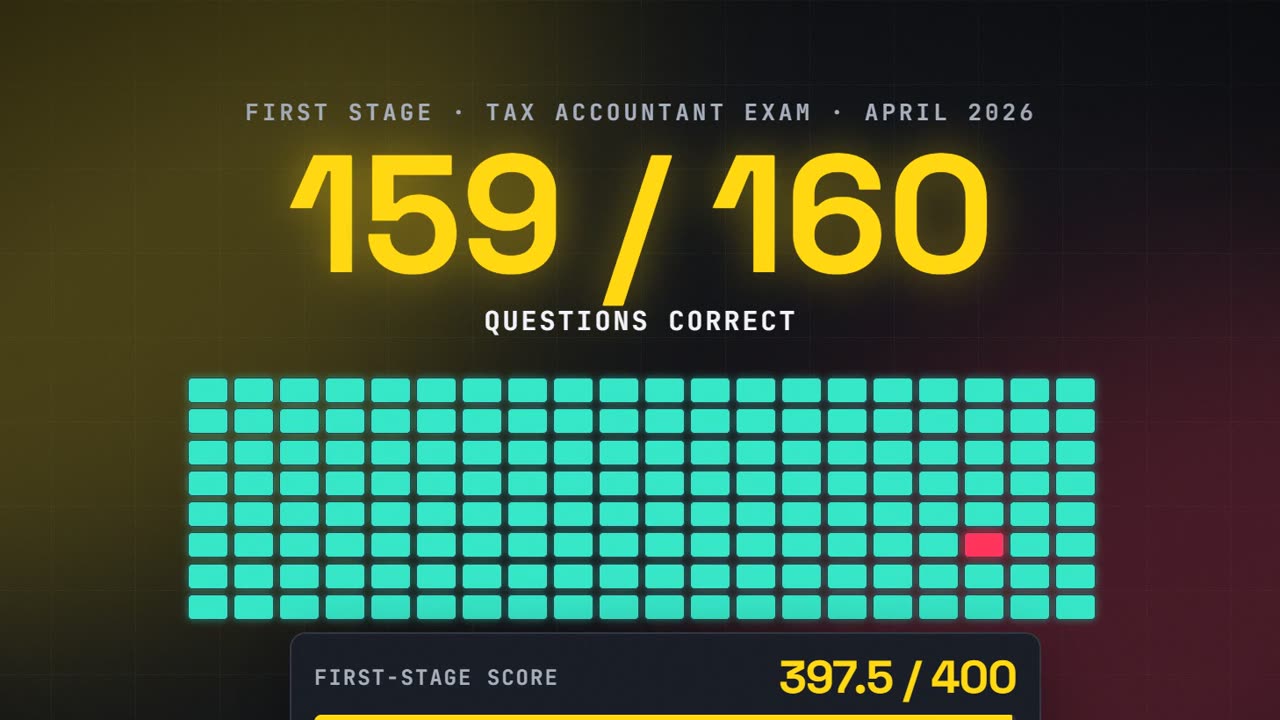
One hundred sixty questions. One hundred fifty-nine right. That was one candidate’s result in the first stage of South Korea’s national tax accountant exam in April 2026: 397.5 out of 400. Three months later the same candidate scored 663 out of 800 in the written second stage and was named the overall top scorer, according to The Korea Times.
Experts — including licensed tax accountants and tax lawyers — called the near-perfect first-stage score “close to impossible”. On Sunday, 15 November, after first denying any wrongdoing, the candidate confessed. What he described, and what South Korea did next, says a lot about where exam cheating is heading.
The score that raised the question
The numbers are what drew attention. Korea JoongAng Daily reported that his only wrong answer in the first stage was in public finance, and that he scored perfect marks in introductory tax law, introductory accounting and commercial law. Introductory tax law was particularly hard that year: the average among the 16,856 examinees was just 30.18 out of 100.
He posted his results online and described passing through self-study. That post is what put him under a spotlight. Online, people started to ask whether such a result was even possible without help — and some suggested AI smart glasses.
Nobody in the room noticed
The exam administrator, the Human Resources Development Service of Korea, initially said it had found no concrete evidence of cheating. The four proctors who supervised him across the two exam stages told the agency they had noticed no suspicious behaviour or signs of cheating, The Korea Times reported.
What he confessed
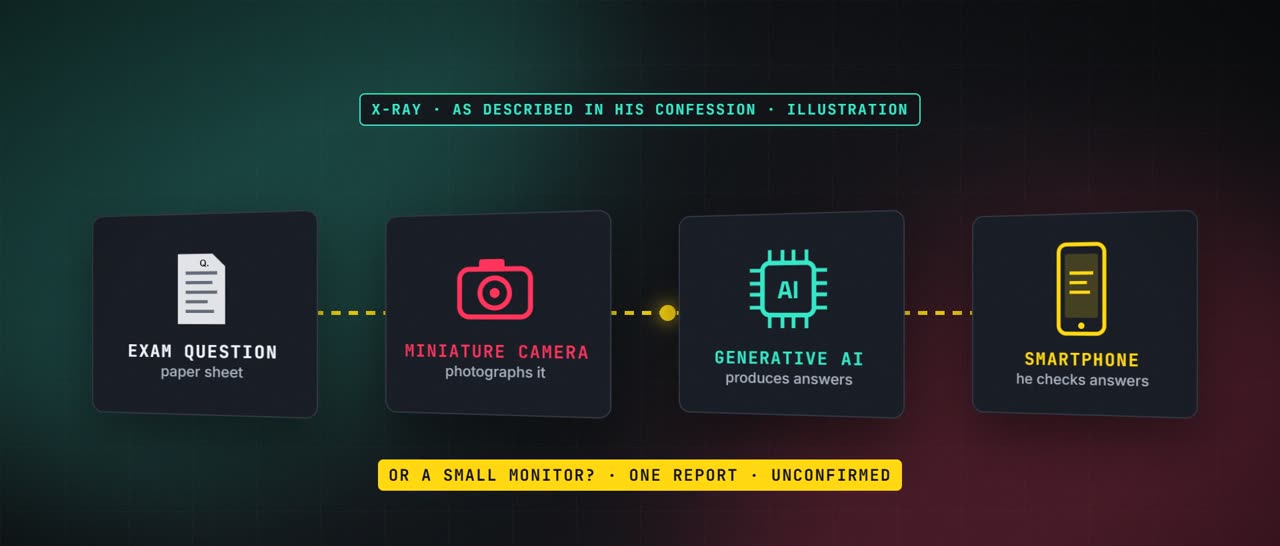
The candidate, identified by Korean media as Han Won-seok, 34, confessed in a video posted on his lawyer’s YouTube channel. “I cheated by using a miniature camera to photograph the exam questions, sending them to AI and checking the answers on a smartphone,” he said, according to The Korea Times. He said he used the same method in the first stage of the certified public accountant (CPA) exam.
Two details matter for how this story is told:
- It was not AI smart glasses. Police said he used a handheld miniature camera “rather than the AI glasses initially suspected”, Korea JoongAng Daily reported.
- The exact method is still not confirmed. The Korea Herald reported that his written confession describes viewing the answers on a small monitor, and JoongAng Daily said the confession detailed an additional device or method and that the exact method “has yet to be confirmed”. He has declined to give full details publicly, saying he does not want others to copy it.
Seoul police opened a formal investigation, he appeared for questioning as a suspect, and the exam administrator apologised and said it would file a criminal complaint. He has confessed; he has not been convicted.
AI glasses are a separate — and real — problem
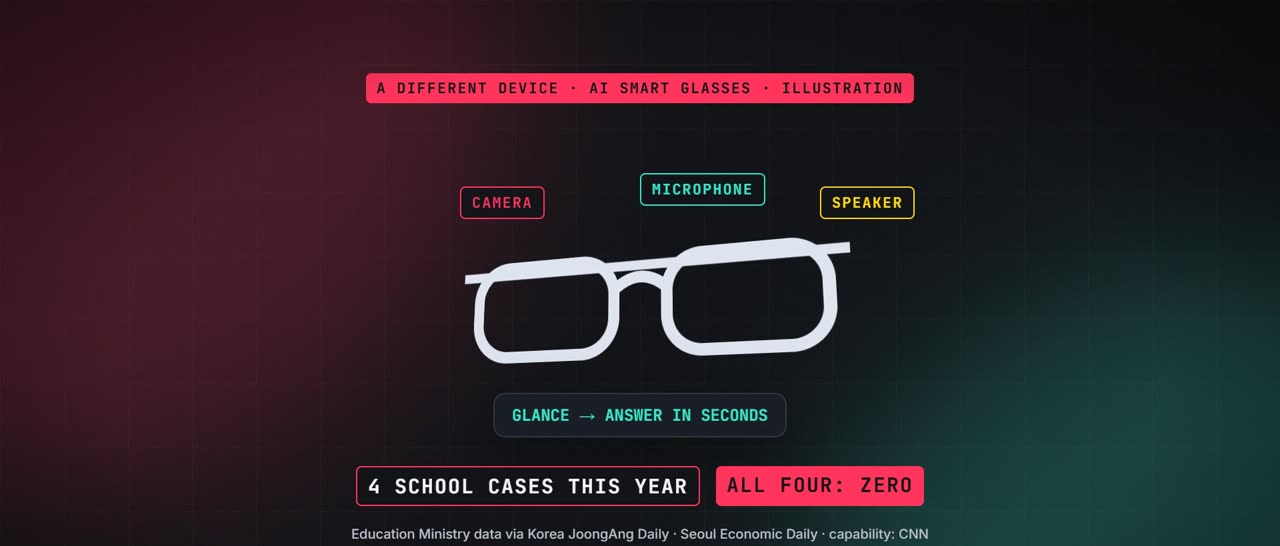
The suspicion about smart glasses was not random. On 9 November, South Korea’s Education Ministry said it had found four cases of students cheating with AI glasses in middle- and high-school exams this year — one middle-school and three high-school students. All four received zero scores on the affected exams.
Smart glasses can integrate cameras, microphones and speakers. As CNN put it, a test-taker wearing AI glasses “can simply glance at a question and have the answer fed back to them in a matter of seconds”. Early designs had obvious cameras in the frame, but newer devices are increasingly hard to tell apart from ordinary glasses, Al Jazeera reported.
South Korea’s response before the Suneung
The confession landed days before Thursday, 19 November, when around 550,000 students were expected to sit the College Scholastic Ability Test — the Suneung. Prime Minister Han Seong-sook called AI-assisted cheating a “social evil” and announced tighter checks. Reported measures include:
- Every pair of glasses inspected. Education Minister Choi Kyo-jin promised “a thorough inspection of all glasses in each test session”, and smart glasses were added to the list of banned items (CNN).
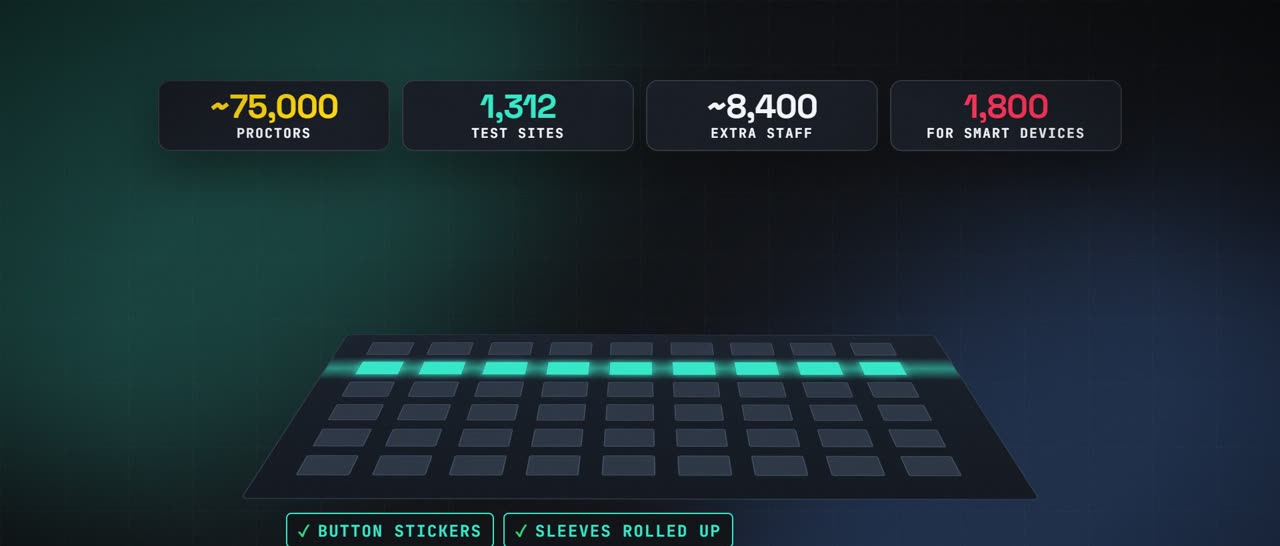
- More people in the halls. About 75,000 proctors at 1,312 test sites, plus about 8,400 additional staff, including about 1,800 dedicated to smart devices (Korea JoongAng Daily).
- Hiding places closed. Stickers over shirt buttons to stop concealed micro-cameras, sleeves rolled up, collars checked and bags left in the hallway.
- An alert you can’t silence. A nationwide emergency text alert before the exam, to remind students to hand in phones and help reveal devices that were not handed in.
- Wi-Fi under review. The Prime Minister asked the Science Ministry to look into disabling public Wi-Fi at test sites during exam hours (Korea Herald).
Penalties
Possible penalties include invalidated results, restricted eligibility for future exams and referral to police. The Democratic Party of Korea proposed raising the maximum ban on retaking the Suneung from one year to ten years; at the time of writing this was a proposal, not law.
What this case actually shows
It is tempting to read this as a story about clever gadgets. The more uncomfortable lesson is about detection. In this case, no proctor caught the candidate; the scrutiny began only after he posted his own scores. Those initial findings, The Korea Times noted, raise the question of whether the cheating would ever have come to light if the scores had been less conspicuous.
That is why South Korea’s response leans so heavily on physical checks — glasses, buttons, sleeves, bags — and on removing the connection between the exam room and an AI model. A senior teachers’ union official told The Korea Herald the measures still rely heavily on teachers to detect cheating and questioned whether they would be effective.
In our view, that is the real test now: spotting AI cheating that does not look like cheating. Exams that assume a sealed room are colliding with cameras smaller than a fingernail and AI models that answer in seconds. Expect more countries to follow South Korea — and China, which already screens glasses at its college entrance exam — with device checks, signal monitoring and tougher penalties.
What we still don’t know
- Exactly how the answers were displayed and how the devices got past the room checks.
- Whether the police investigation will lead to charges, and what penalties will apply.
- How effective the Suneung measures were on the day.
Sources checked 18 November 2026. This is a developing story; we will update it as the investigation progresses.